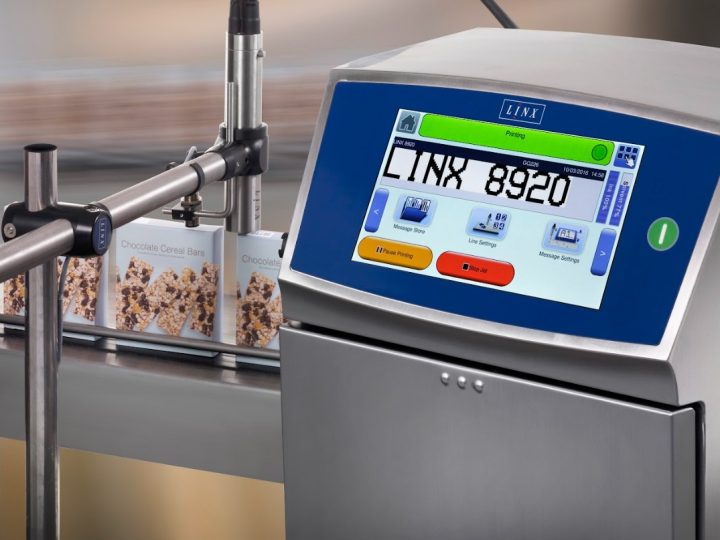
A traversing inkjet printer for manufacturing is used as a motion-controlled printer that moves the printhead along a pre-programmed X or Y axis instead of having the printhead remain in one place.
One traversing printer can be programmed to print on large objects, multiple lanes of packaging, or at many different places. This type of printer will reduce the amount of equipment needed while maintaining full control over printing codes in factories where there are multiple format types being run on the same production line.
What is a Traversing Inkjet Printer for Manufacturing?
A traversing inkjet printer for manufacturing combines a CIJ or TIJ coder with a motorised carriage, guides, sensors and a motion controller. The printhead will move horizontally or vertically across a surface, then print at pre-programmed coordinates. Some systems will also operate during the parent machine’s dwell time.
Common Printing Challenges in Manufacturing Environments
Large manufacturing operations typically encounter problems related to changing widths of packages, running multiple lanes of product, inconsistency in positioning of codes, and limited space. Installing one printhead per lane will increase consumption of consumables and require additional maintenance.
In the manufacturing application of inkjet systems, operators tend to replace ink/ribbon prematurely to prevent running out of material. Issues associated with excessive waste, wear and tear on components, and proper disposal of solvents also have been addressed in several fields.
Why Choose a Traversing Inkjet Printer for Large-Scale Production?
A traversing inkjet printer for manufacturing brings several coding positions under one controller. Based on DSI’s field experience, it suits various different lines where formats or lanes change. Operators manage fewer devices, while programmed movement limits manual repositioning.
Key Features of a Traversing Inkjet Printer
A successful traversing inkjet printer for manufacturing must strike a balance between speed, mechanical stability, print quality, and connectivity with the production machine. Here are the key features you should note:
-
Wide Printing Coverage
Here, the carriage can travel to areas beyond where a stationary head could reach, making it practical for wide products and multi-lane packages.
-
High-Speed Traversing Motion
Servo controlled travel minimizes time spent traveling between print locations. However, each pass must fall within the machine cycle.
-
High-Resolution Variable Data Printing
Variable data such as date/lot number, text/barcodes/traceability information can be applied without using plates or screens
-
Seamless Integration with Production Lines
Sensors and controller signals allow coordination of printing with conveyors and form-fill-seal equipment.
-
Automated Printing for Large Products
Stored positions eliminate repetitive adjustments when product dimensions or code positions change.
-
X and Y Axis Servo Drives Ensure Precise Print Positioning
Simply put, the servo-driven X-Y CIJ systems can position the printhead at repeated coordinate positions across rows and lanes.
Typical Manufacturing Applications
Using the same motion technology as an inkjet printer used for printing on cartons, etc., allows this technology to be used on many other types of materials as long as there is an adequate match between ink/mounting/print distance, including:
-
Corrugated Cartons and Packaging
Boxes and multi-lane packages can have batch information, shipping information, or bar codes printed on them at various locations.
-
Lumber and Wood Panels
Broad boards can have grade, dimension, production date, or identification numbers printed on them.
-
Metal Sheets and Pipes
Using this system, pipe sections or sheet metal can also be marked with job number and traceability codes.
-
Pallets and Industrial Containers
Large containers or pallet faces can be coded without having to move the container past multiple print heads.
-
Construction Materials
Panels, tiles, and insulating materials can be marked with specification/batch information over large areas.
Factors to Consider When Selecting a Traversing Inkjet Printer
When selecting a traversing inkjet printer for your production environment, consider these factors:
| Factor | What to Check |
| Motion | Travel width, cycle time, vibration control |
| Product | Spacing, code size, clearance |
| Printing | Substrate, ink adhesion, nozzle access |
| Integration | Encoder accuracy, machine signals, timing |
| Installation | Rail protection, cable routing, washdown needs |
Benefits of Implementing a Traversing Inkjet Printer in Manufacturing
Implementation of a traversing inkjet printer for manufacturing in your production environment provides several advantages including; increased print area coverage, reduced number of print heads required, faster format changes, less manual adjustment, and improved utilization of a single coding system.
Also, utilizing fewer pieces of equipment may allow for easier management of consumables and service requirements.
While rails, drives, sensors and moving cables still require periodic inspection, overall maintenance costs associated with a traversing inkjet printer are typically lower than those associated with multiple fixed print head systems.
View DSI’s industrial inkjet printer product line to identify a traversing inkjet printer that fits your existing line layout and coding needs.
Frequently Asked Questions (FAQ)
-
Can a single traversing unit print across several lanes?
Yes, as long as the dwell time permits the print head to reach all programmed positions.
-
Is it compatible with CIJ and TIJ printers?
Yes. The compatibility of a traversing inkjet printer with other types of printers will depend on the design of the system, the method of mounting, and the specific application.
-
Does it need more maintenance than a fixed head?
Because it contains additional moving components, rail cleaning, alignment checks, and drive inspections are necessary.