In high-volume beverage production, selecting the right continuous inkjet printer for cans is critical for maintaining speed, accuracy, and regulatory compliance.
Aluminum and metal cans move rapidly through filling and sealing lines, often exceeding 1,000 cans per minute in large-scale facilities. In such demanding environments, coding technology must deliver clear, durable marks while operating seamlessly within the continuous production flow.
Why Coding on Cans Requires Specialized Printing Technology
Coding on beverage cans is not as simple as printing on flat cardboard. Here are several factors that make can coding require specialized printing technology:
Production Speed and Line Efficiency
Beverage lines operate at exceptionally high speeds. In large facilities, filling lines can run between 600 to 2,000 cans per minute depending on configuration. Any delay in printing can cause bottlenecks that reduce overall equipment effectiveness (OEE).
A continuous inkjet printer for cans must therefore support the following:
- High-speed marking without interrupting line movement.
- Rapid ink drying to prevent smearing.
- Consistent print clarity at full line speed.
CIJ technology is widely used in high-speed manufacturing because it prints continuously without mechanical contact, allowing stable marking even in fast-moving environments.
Challenges of Printing on Curved and Metallic Surfaces
Cans are cylindrical and typically made of aluminum or coated metal. These surfaces are non-porous and reflective, which can affect ink adhesion and contrast. Additionally, condensation may form when cold-filled beverages exit the filling station.
Without appropriate ink formulation and precise droplet control, printed codes can smear or fade. This is why a continuous inkjet printer for cans must be configured with inks designed specifically for metal adhesion and moisture resistance.
How Continuous Inkjet Printers Work for Can Coding
Continuous Inkjet (CIJ) technology operates by propelling a continuous stream of ink droplets that are electrically charged and directed onto the substrate. This is how the technology improves can coding performance:
Non-Contact Printing for Maximum Stability
Non-contact printing ensures that no physical pressure is applied to the can surface. This prevents distortion or vibration-related print defects at high speeds.
In beverage production lines where cans move rapidly on conveyors, stability is essential. A continuous inkjet printer for cans maintains consistent droplet placement even when minor mechanical variations occur. This reduces misprints and supports long-term line efficiency.
Ink Technology for Metal and Aluminum Cans
Ink formulation is a critical factor in can coding performance. For metal surfaces, fast-drying solvent-based inks are commonly used. These inks are engineered to:
- Bond effectively to aluminum and coated metals.
- Resist moisture and condensation.
- Withstand abrasion during packaging and transport.
CIJ inks designed for food and beverage packaging provide durable marking that remains legible throughout distribution.
Read About: Coding Solutions for the Alcoholic Beverage Industry: Reliable, Fast, and Compliant
Key Applications of Continuous Inkjet Printers in Can Packaging
Coding on cans is not limited to simple date stamping. Modern production requires comprehensive identification to support compliance and operational transparency. Key applications include the following:
Date, Lot, and Batch Coding
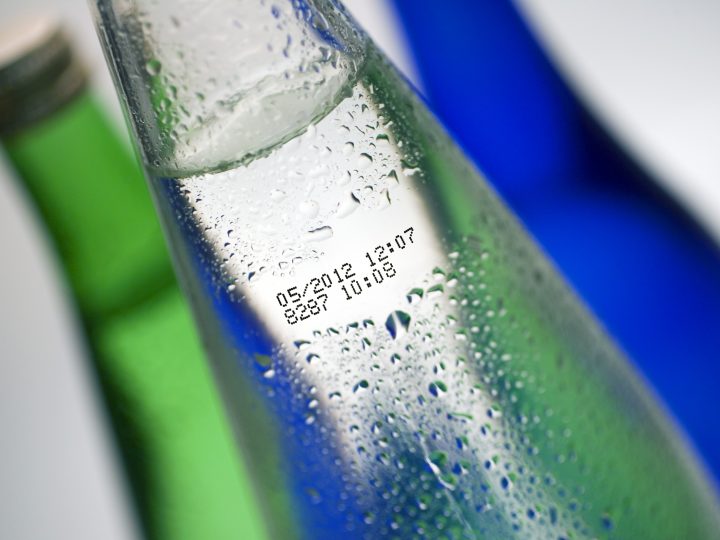
Production dates, expiration dates, and lot numbers are essential for inventory management and recall readiness. A continuous inkjet printer for cans ensures these codes are printed clearly on the base or top of each can without slowing the production line.
High-resolution small-character printing allows compact yet legible codes, even within limited surface areas.
Regulatory Compliance and Traceability
In food and beverage industries, traceability is mandatory. Accurate coding enables rapid identification in case of quality issues. It also supports automated scanning systems integrated with broader supply chain traceability platforms.
Continuous inkjet systems are commonly used in food and beverage applications because they ensure consistent, high-speed marking aligned with regulatory compliance requirements.
Reliable coding is therefore not only an operational necessity but also a regulatory safeguard.
Benefits of Using Continuous Inkjet Printers for Cans
When properly configured, a continuous inkjet printer for cans provides measurable operational advantages. Here are the main benefits:
High-Speed Performance Without Compromising Print Quality
CIJ technology is specifically designed for continuous production. It supports uninterrupted marking at full line speed while maintaining character clarity and contrast.
Even at extreme throughput levels, droplet precision ensures uniform code placement. This consistency reduces rejection rates and improves overall production efficiency.
Low Maintenance and Operational Flexibility
Modern CIJ systems are engineered for minimal downtime. Automated cleaning cycles and user-friendly interfaces simplify maintenance routines.
Additionally, a continuous inkjet printer for cans can adapt to various code formats, including multi-line text, logos, and barcodes. This flexibility supports product variation without requiring significant mechanical adjustments.
Choosing the Right Continuous Inkjet Printer for Can Production Lines
Selecting the right continuous inkjet printer for cans requires evaluating both technical specifications and operational requirements. Key considerations include:
- Line speed compatibility and maximum print frequency.
- Ink adhesion performance on aluminum surfaces.
- Environmental conditions, including humidity and temperature.
- Maintenance requirements and service support.
- Scalability for future production expansion.
An integrated assessment ensures that your chosen system aligns with long-term manufacturing strategy rather than short-term output demands.
Partnering with an experienced provider such as DSI enables you to configure a continuous inkjet printer for cans that matches your beverage line’s speed, substrate characteristics, and regulatory requirements.
DSI offers advanced CIJ solutions supported by technical consultation and after-sales service to ensure optimal performance in demanding production environments. To explore industrial-grade solutions tailored to your beverage production needs, see a complete list of continuous inkjet printer here.
Consult with DSI to identify a solution engineered for high-speed beverage manufacturing and long-term reliability.
References:
- https://www.videojet.com/us/homepage/resources/faqs/faq-small-character.html
- https://www.needham-ink.com/blog/what-can-a-cij-printer-do
- https://www.leadtech.ltd/a-why-continuous-inkjet-printers-are-ideal-for-food-and-beverage-packaging.html
- https://www.correct-pack.com/a-news-applications-of-continuous-inkjet-printers-in-food-and-beverage-industries.html
- https://www.domino-printing.com/en/products/ax-series